DISCLAIMER: This report is for educational purposes only and does not constitute financial advice. It is not a recommendation to buy or sell any securities. All investments involve risk, including the loss of principal. This report is FTC compliant. Past performance is not indicative of future results.
Goat Academy | Research
Published August 2026
US Debt · Liquidity & Money Supply
The September 9th Money-Printing Flood
Why the Treasury is about to start buying its own debt with fresh money — and what that quietly does to your savings
Bottom line:
Starting September 9th, the US Treasury doubles how much of its own debt it buys back, to $4 billion per operation. The video script argues this is money printing under a softer name — a response to a 30-year borrowing rate that just hit its highest level since 2007, and to an interest bill that already runs $1.4 trillion a year. This report follows the script's information and order.
Sept 9
the date the Treasury's expanded buyback operations begin, as described in the script
Goat Academy | Research
About
About Felix Prehn and Goat Academy
Felix Prehn
Felix Prehn is a former investment banker. He left that world to teach regular people the strategies and principles that professional investors use to build and protect wealth.
Goat Academy
Felix Prehn is the founder of Goat Academy, an educational platform that has taught more than 20,000 students the fundamentals of investing and stock market analysis. Goat Academy focuses on making Wall Street's methods understandable for regular investors.
The academy provides training on fundamental analysis, technical analysis, risk management, and portfolio construction — helping individual investors make informed decisions about their financial futures.
The Winston app
Winston is Goat Academy's research app. Among other things, it tracks the trades that politicians and other public officials file, translates them into plain English, and puts the full public record in one place. This report uses the app as its on-screen source for the Trump filing data.
Mission
Felix's approach emphasizes understanding the fundamental forces that drive markets — here, government debt and the money supply — rather than chasing short-term trends. The goal is to level the playing field between Wall Street professionals and everyday investors.
Read it beside the video. The sections follow the script's information and its order. The goal is not to predict the next market move. It is to explain, in plain English, what a government does when it starts buying its own debt — and why that matters for the money in your bank account.
Goat Academy | Research
Executive Summary
Bottom Line
One machine, one goal: push the rate down
Bottom line:
A borrowing rate at a 17-year high, an interest bill of $1.4 trillion a year, a doubled debt-buyback program, a quiet mechanism the script calls stealth money printing, and a President floating the military over bond markets — the script presents these as parts of one machine with a single purpose: get the government's borrowing cost back down.
Borrowing rate spikes to 5.27%
→
Interest bill becomes unpayable
→
Government prints and buys its own debt to force the rate down
The trigger
A 30-year yield of 5.27%. That is the highest since 2007. A higher government borrowing rate pulls up mortgages, car loans and credit cards with it.
The response
The Treasury doubled its buybacks to $4 billion per operation. The script's plain-English reading: the government became the buyer of its own debt because others would not lend at a price it could afford.
The reason
The interest bill is the trap. $1.4 trillion spent on interest over the last 12 months, projected toward $1.7 trillion a year. Lower rates are the only exit that avoids real pain.
The lesson
Cash is what they are printing. When the money supply is watered down, sitting entirely in cash quietly loses purchasing power. That is the cost the script asks you to plan around.
Goat Academy | Research
One Machine
The Five Pieces
Why separate headlines share one cause
What you see
What the script says it is
Connection
30-year yield at 5.27%
Highest borrowing rate since 2007
The problem that starts it all
Buybacks doubled to $4B
Government buying its own debt, from Sept 9
The blink
$1.4T interest bill
Rising toward $1.7T a year by 2028
Why they had no choice
Fed buying short-term paper
Fresh money used to hold rates down
The part they don't call printing
Trump's filed trades
Big money into cash-flow businesses, out of hot AI names
Someone positioning for it
Key idea.
The script does not treat these as five unrelated news items. It treats them as evidence of one goal — forcing the government's borrowing cost lower — and of the money printing that goal requires.
1
goal: lower the borrowing rate
5.27%
30-year yield, highest since 2007
Sept 9
buyback flood begins
Stock and trade data source: Winston app, app.goatacademy.org. Other figures are taken from the approved script and its source notes.
Goat Academy | Research
The Blink
The First Warning Light
A 5.27% yield, then a doubled buyback
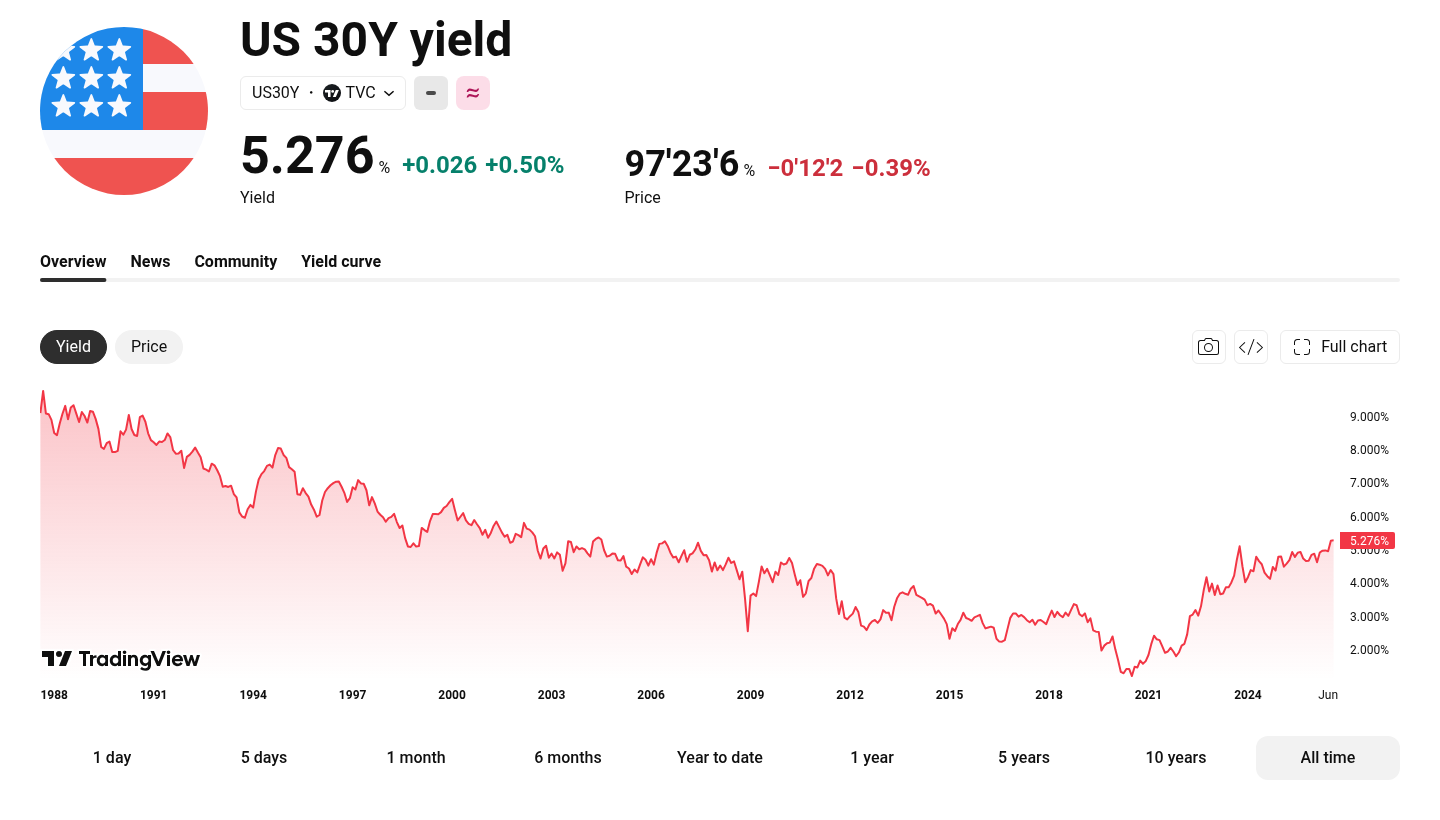
US 30-year Treasury yield. The script notes the rate reached 5.27% — the highest since 2007. A yield is simply the interest rate the government pays to borrow. Chart source: public market data (TradingView).
Why the rate matters
It sets the price of everything. When the government's borrowing rate rises, mortgages, car loans and credit cards get more expensive with it. The script flags 5.27% as the highest reading since 2007.
What they did
They doubled the buybacks. A few days later the Treasury announced it would double how much of its own debt it buys back, to $4 billion per operation, under the name “liquidity support.”
The plain reading
They blinked. The government became the buyer of its own debt because not enough others would lend to it at a price it could afford. The expanded operations begin September 9th.
Goat Academy | Research
“Liquidity Support”
The Name They Gave It
A soft name for a big change
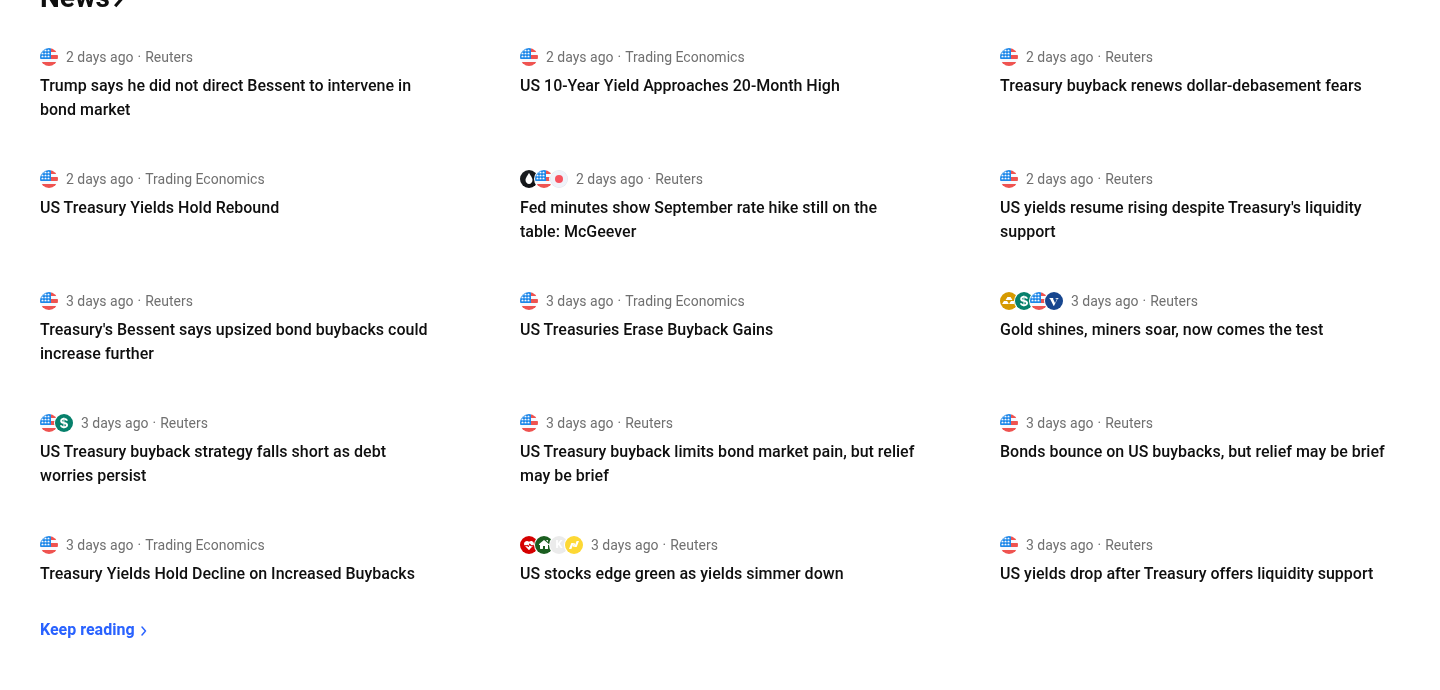
Reporting on the Treasury's expanded buyback operations, referenced in the script. The program is described publicly as “liquidity support.”
Why the name matters.
“Liquidity support” sounds routine and technical. The script's argument is that the plain-English version — the government printing to buy its own debt — is the thing that actually affects your savings, and that the soft name is exactly why most people miss it.
$2B
prior buyback size, per the script's framing
$4B
new size per operation — doubled
Sept 9
start date
The $4 billion per-operation figure and the doubling are stated in the script and its source notes.
Goat Academy | Research
The Debt Trap
Why They Had No Choice
$1.4 trillion, just on interest
Bottom line:
Over the last 12 months the US government spent $1.4 trillion on interest alone — not roads, not defense, not healthcare, just the cost of money it already borrowed. The script projects that toward $1.7 trillion a year by 2028, and argues this is why the printing makes sense to the people doing it.
$1.4T
interest paid, last 12 months
$1.7T
projected annual interest by 2028
$39T+
total US debt, growing ~$8B/day
The credit-card trap
You open a new card to pay the old one. The script's analogy: the minimum payment alone is eating you alive, so you borrow again to cover it. That is where the government sits.
The only painless exit
Push the rate back down. Lower yields shrink the interest bill. The script argues every move that follows — the buybacks, the printing — serves this one goal.
The motive
No one needs low rates more. When a borrower needs something this badly, the script warns, they will do things they would not normally admit to.
Goat Academy | Research
Stealth Printing
The Part They Don't Call Printing
New money, three quiet steps
1. The Treasury issues short-term IOUs (bills)
→
2. The Fed prints money to buy those bills
→
3. The Treasury uses that cash to buy long-term debt — pushing its price up and its rate down
Follow the money
New money holds down the borrowing cost. Money is created and ends up suppressing the government's own interest rate. The script's verdict: that is money printing, full stop.
Why they won't call it QE
A technicality. Because the Fed is not buying the long-term bonds directly, officials can say “this isn't QE.” The script calls it a magic trick — same result, different name tag.
The detail that stands out
Faster than Covid. The script notes the Fed is buying this short-term government paper faster now than during the Covid shutdown — and almost no one is discussing it.
What QE means.
QE, or quantitative easing, is the name for a central bank creating money out of nothing to buy bonds and force rates down. It was used in 2008 and 2020. The script argues it is happening again now, under a different label.
Goat Academy | Research
The Military Quote
How Desperate They Are
“The ultimate intervention is our military”
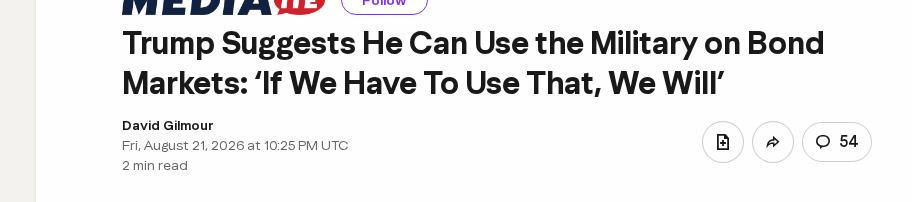
Reporting on the President's remark, referenced in the script. Asked about further bond-market intervention, he said: “The ultimate intervention is our military, and if we have to use that, we will.” Source: Mediaite via Yahoo News, David Gilmour, Aug 21 2026.
Read past the joke
People online made light of it. The script asks you to step past the joke and see what it reveals: the military raised in the same breath as the government's borrowing cost.
What it signals
Desperation to lower the rate. Whatever you think of the man, the script's reading is that floating the military to get borrowing costs down shows how badly the number needs to come down.
The takeaway
Watch bonds. The script keeps returning to one instruction: the whole story lives in the bond market, so that is where to keep your eyes.
This report is not political. It repeats the quote and its context only as described in the script.
Goat Academy | Research
The Insider
What Trump Is Doing With His Own Money
Over 600 trades in a single filing
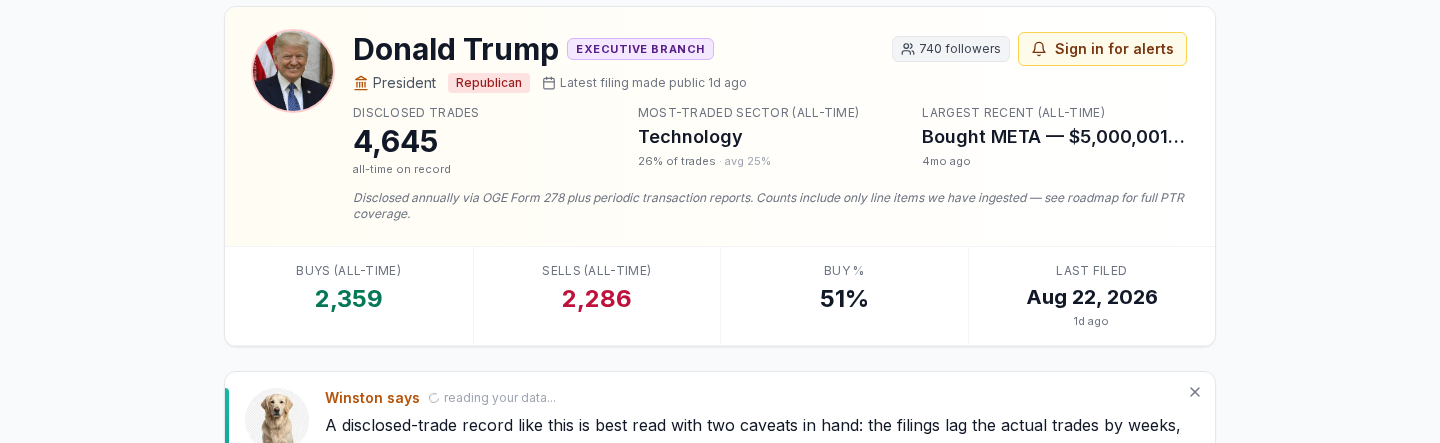
The Winston app's Trump page. More than 4,000 trades are on record; the latest filing added over 600 line items in a single drop. Source: Winston app, app.goatacademy.org.
Bottom line:
While the government quietly prints to prop up its own debt, the latest disclosure shows where a person with that kind of access moved his own money. The app makes the full public record readable — and the pattern lines up with the story the script just told.
The record
More than 4,000 trades on file. The latest filing alone added over 600 line items. This report reads only what the app shows on screen.
The method
Public record, in plain English. The app tracks what these officials file and translates it. Nothing here is private or inferred — it is the disclosure itself.
Goat Academy | Research
The Pattern
Toll Booths In, Hot AI Out
Follow what the money does
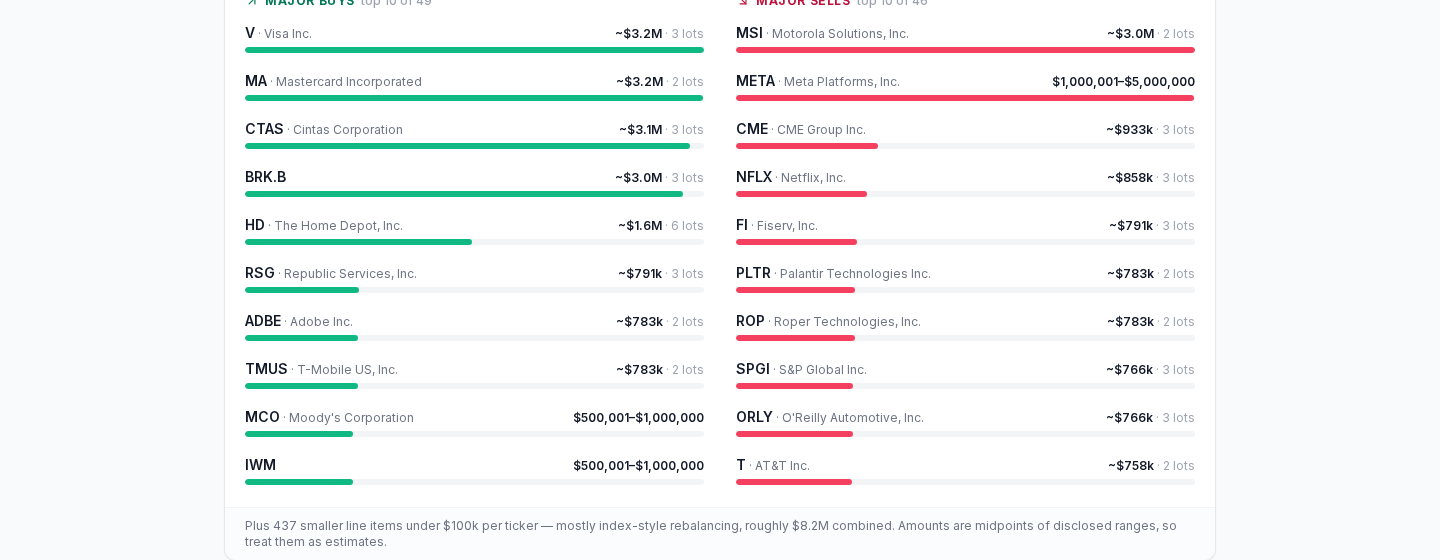
The largest tickets in the latest filing, as shown in the app: big buys in green, sells in red. Source: Winston app, app.goatacademy.org.
On the way in (big buys)
What it is
On the way out (sells)
Visa, Mastercard
Toll booths — a cut of every card swipe
Meta
Berkshire Hathaway
A giant pile of cash and steady businesses
Palantir
Cintas, Home Depot, Republic Services
Real businesses with cash coming in daily
Netflix
The tell.
Big money moved into toll booths, cash machines and Buffett-style cash — and trimmed the crowded AI names everyone else is chasing. Those are exactly the assets the script says tend to do well when the money supply is being watered down. The report draws no conclusion beyond the pattern the app displays.
Goat Academy | Research
What It Means
What This Means for You
The tax nobody votes on
Bottom line:
When a government prints money to paper over its own debt, the value of every dollar quietly leaks away. The script's central warning: sitting entirely in cash feels safe, but cash is exactly what is being printed more of.
The cash trap
Safe from what? Your money can hold its number and still buy less every month. The script calls this the tax nobody votes on — you did not lose dollars, but each one stretches less far.
Where money tends to go
Hard assets and real cash flow. Historically, the script says, money flows to hard assets, to businesses that throw off cash — the toll booths — and gold and metals tend to have their moment too.
The biggest mistake
Waiting for the news. By the time the “money printing” story runs with scary graphics, the easy move is gone. The point of watching now is to understand it before then.
The script's image.
Cash in a printing cycle is like standing still while the floor drops. Keep what you need for safety — but understand that long-term, idle cash is where the erosion is designed to land.
Goat Academy | Research
A Simple Framework
How to Think About It
Don't sit still while the floor drops
1
sit in cash and hope
2
wait until it's on the news
3
understand it early and plan
Don't over-hold cash
Keep a buffer, not your whole life. The script warns that excess long-term cash is what a printing cycle erodes. Safety money is fine; idle wealth is the target.
Own what copes with paper-money stress
Hard assets and real cash flow. Real businesses that generate cash, plus hard assets like gold and metals, are the script's examples of things that tend to hold up.
Own the plumbing
The toll booths. Businesses that take a small cut of activity regardless of the headlines — the script's recurring image for durable, inflation-resistant cash flow.
What this is not.
This report names no security to buy and gives no rating or price target. It explains the framework the script describes so you can apply your own judgment.
Goat Academy | Research
Action Checklist
Turn Understanding Into Process
Five questions before the flood
Do I understand that “liquidity support” and the doubled buyback are, in plain English, the government buying its own debt?
Is too much of my long-term wealth sitting idle in cash while the money supply is expanded?
Do I own real businesses that generate cash — the toll booths — rather than only crowded, hot themes?
Have I considered whether hard assets like gold and metals belong in my plan?
Am I positioning early, or waiting until the money-printing story is on the news?
Free live training: how to protect your 401k, pension and retirementsurvivethebubble.com
Grab your free ticket · show up live · bring your questions · there is no replay
This is the only call to action in this report.
Goat Academy | Research
Sources & Disclosures
References
Sources & disclosures
Video: “Trump to FLOOD the Market on THIS Date (Most Aren't Ready)” by Felix Prehn, Goat Academy.
Winston app:app.goatacademy.org — Trump trade filing data and stock-related context.
Treasury buybacks, 30-year yield, interest bill: figures as stated in the script and its source notes (buybacks doubled to $4B per operation from September 9; 30-year yield 5.27%, highest since 2007; $1.4 trillion interest over 12 months, projected toward $1.7 trillion by 2028).
Military quote: reporting by Mediaite via Yahoo News, David Gilmour, Aug 21 2026.
Images: 30-year Treasury yield chart (public market data), buyback-program reporting, the military-quote headline, and the Winston app's Trump trades page.
Full educational disclaimer
This report is for educational and informational purposes only and does not constitute financial, investment, legal, tax or accounting advice. It is not a recommendation, solicitation or offer to buy or sell any security, currency, commodity or financial product. No buy/sell rating or price target is provided. All investments involve risk, including the possible loss of principal. Government policy, market events and historical comparisons described here may not repeat. Illustrations simplify complex systems and may omit factors. This report is not political; it repeats public statements only as described in the video. Readers should conduct their own research and consult appropriately qualified professionals before making financial decisions. Past performance is not indicative of future results. Goat Academy and Winston make no guarantee regarding outcomes.