 Winston
Stocks climb but 30-year borrowing costs hit pre-2008 levels
The S&P 500 gained half a percent to 7,667 while the interest rate on 30-year government debt pushed back toward 5.2%, a level not seen since before the financial crisis.
Wednesday, 2 September 2026
The S&P 500 rose 0.47% to 7,667 on Wednesday. The Dow cleared 53,000. And the VIX, which measures how nervous stock traders are, dropped nearly 7% to 15.2.
Bonds tell a different story. The 30-year Treasury rate, what the government pays to borrow for 30 years, is back near 5.2%. That number hasn't appeared since before 2008. And private employers added just 38,000 jobs in August. Thinnest month since January. So you've got green screens on one side and the weakest hiring in 8 months on the other, and somebody is wrong.
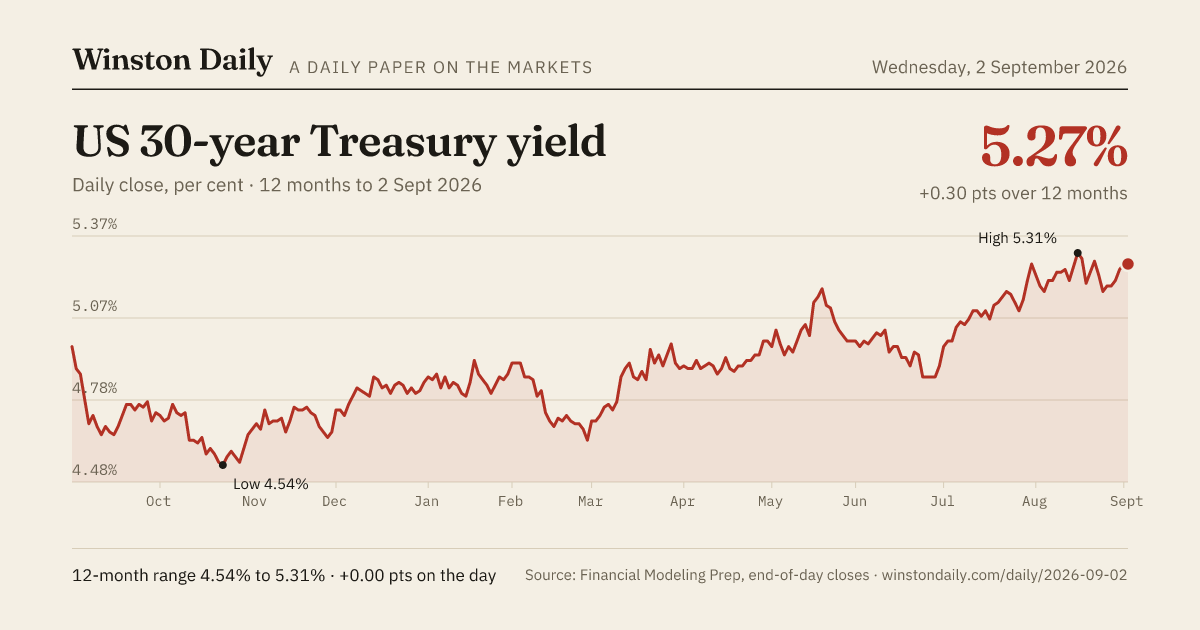
Bonds are not buying it
The 10-year Treasury closed at 4.795%. The 30-year is near 5.2%. If you've got a mortgage coming up for renewal, those numbers set the floor for what you pay.
Two things are pushing them. Oil at $95.27 a barrel feeds into the price of nearly everything, and that keeps inflation sticky. But there's also the sheer volume of bonds Washington needs to sell to cover its deficit, because when there are more bonds for sale, buyers demand a better return before they'll lend.
Treasury Secretary Bessent expanded a bond buyback programme, where the government buys back its own debt early, to try to cap long-term rates. So is it working? The 30-year hasn't broken above 5.2% yet. But it keeps knocking on the door.
Three Fed officials, one week
New York Fed President John Williams said Wednesday he's open to raising interest rates. First hike since 2023, if it happens. Fed Chair Warsh hinted at the same on August 30 and again August 31. Governor Barr backed one on Monday.
So 3 senior officials in 7 days. And yet private hiring came in at 38,000 against the 47,000 economists expected.
Williams tried to square it by saying the jump in borrowing costs reflects a strong economy, not an inflation scare. Maybe that's right. But if you're paying 4.8% on your next loan, the reason behind it doesn't make the payment smaller. Now he says he's still collecting data, which is Fed language for not committing to anything before Friday's payrolls number.
Oil and the Gulf
Brent settled at $95.27. WTI closed at $90.67, up 0.50%. Fresh strikes and Iranian retaliation near the Strait of Hormuz pushed both higher. About a fifth of the world's oil moves through that waterway.
Gulf flows are still roughly 60% below normal. 6 months in.
Bessent says the Hormuz route will eventually be bypassed and become worthless, which is a confident thing to say at $95 a barrel, given that pipelines and new shipping lanes take years to build, not weeks. And Ryanair is already cutting winter flights because unhedged jet fuel is running at $140 a barrel. So the oil shock is not a market abstraction for you any more, it's showing up in the number of seats available for your cheap winter holiday and the price of the ones that remain.
Inside China, Sinopec is locking in discounted Russian crude to replace lost Iranian barrels. The smaller independent refiners, called teapots, are getting starved of supply from both sides. If those plants start shutting units, global fuel supply tightens further.
Uber and the job market
Uber is cutting up to 3,300 jobs. About 1 in 10 of its workers gone.
Now the company calls it an efficiency push. And maybe it is. But 3,300 people is a lot of efficiency. That lands on the same day private hiring came in at its weakest since January, and the question you should be asking is whether companies can keep growing revenue when the people doing the buying are getting fewer.
Friday's government payrolls report is where that question gets an answer.
Grid stress in the heat
Grid operators across the Midwest and Mid-Atlantic warned Wednesday that blackout risk is rising as intense heat pushes electricity demand toward system limits. No outages yet. Just a forecast.
But natural gas tends to follow oil higher. And the capital to build or repair grid infrastructure costs nearly 4.8% right now if you're a utility borrowing to do it. So the fuel running your power plant is expensive, the money to fix the wires is expensive, and you're sitting there with your air conditioner on, at the end of that chain.
Spot metals
Spot gold at time of writing is $4,385.13, up from a previous close of $4,328.63. That's a 1.3% jump. Tuesday saw a sharp 2.75% selloff and Wednesday gave it all back.
Equities were calm. Gold was not. Make of that what you will.
Silver is $65.21, up from $64.01. Copper is $6.60 per pound.
G-III Apparel after hours
G-III Apparel reported Q2 revenue of $554 million, missing the $570 million estimate by 2.9%. But earnings hit $0.26 a share against $0.23 expected, and shares rose 3.5% after hours.
Gross margin, the slice kept after making the clothes, jumped to 45.2% from 36.0% two quarters ago. The company says it priced products to absorb tariff costs. So sales were lighter but every dollar of sales was fatter, and the market decided that was enough.
What is scheduled next
Friday's government payrolls report is the week's hinge. If the official number looks anything like Wednesday's 38,000 private figure, the case for sitting still on rates gets loud. And if it comes in strong, 3 Fed officials who floated a hike this week will look like they meant it, and the 30-year rate near 5.2% stops looking like a ceiling for you and starts looking like a floor.
About this issue
Issue compiled from the Wednesday, 2 September 2026 desk notes. Page published Friday, 25 September 2026. Metal prices are spot at the time of writing. Figures come from the sources set out in the editorial standards. Corrections: [email protected].
Winston Daily is a publication, not a broker or adviser. Nothing on this page is investment advice. Prices and figures are as reported on the day and may have changed.