 Winston
Oil at $97 and a surprise jobs report point the same way
The 10-year Treasury rate closed at 4.784% and traders now price 60% odds of the first Fed rate hike in over a year.
Monday, 7 September 2026
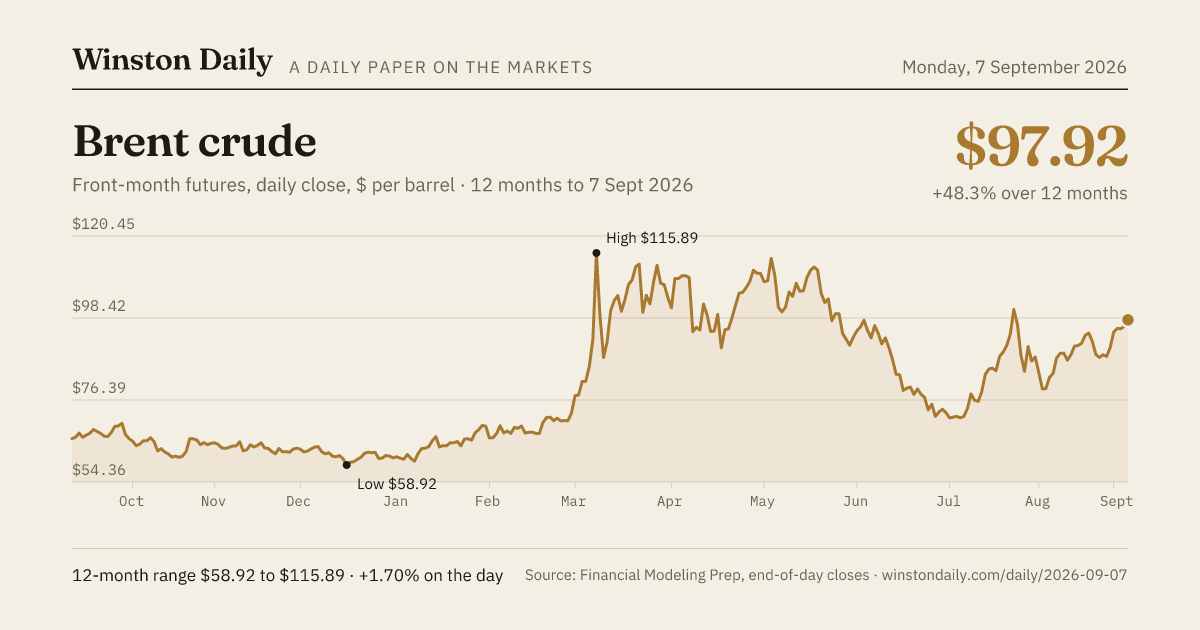
Brent crude settled at $97.27 on Monday after strikes hit Saudi Aramco facilities. The S&P 500 slipped 0.38% to 7,718.6. The 10-year Treasury rate climbed to 4.784%.
Everything is pointing toward higher borrowing costs, not lower. And Friday's inflation report could settle whether the Fed actually raises rates on 17 September, which would hit your mortgage, your car loan, your credit card. All of it reprices.
Bonds and stocks
4.784%. Highest weekly close on the 10-year since October 2023. If you're renewing a mortgage or rolling over variable-rate debt, that number is already in what you'll pay.
The Dow fell 0.51% to 53,414.25. Nasdaq closed at 26,506.99.
Now the part that should bother you. More than $1.1 trillion in buyback authorisations, board-approved plans for companies to buy back their own shares, kept a steady bid under stocks all summer. Those programmes are going dark as companies enter pre-earnings blackout windows. So the biggest consistent buyer of American stocks is stepping aside right as rates and oil push higher.
Who fills that gap? With bonds paying close to 5%, why would you put fresh money into equities? And some of those headline earnings aren't what they look like. Alphabet and Amazon reported profits boosted by large investment revaluations, paper gains on stakes they hold. Strip those out and the growth picture thins.
Oil and the Gulf
You've watched this staircase. Oil topped $90 on 1 September. Neared $95 by midweek. Now $97. WTI rose to $92.70.
Aramco has not confirmed any output losses.
If barrels are actually off the market, you're looking at $100 oil. Diesel already hit a record $5.85 a gallon last week, and Hormuz oil flows were running about 60% below normal as recently as 30 August. Neither side disputed that figure. So who benefits from you believing this calms down soon?
The Fed and Friday
162,000 new jobs in August. Wall Street pencilled in roughly a third of that.
A month ago the odds of a September hike were close to zero. Now 60%. But wage growth cooled to its slowest pace since 2021 and unemployment held at 4.1%, so you have lots of hiring and workers not getting paid much more, and you'd think the Fed would notice that before reaching for the rate lever.
Will they? Friday's CPI, the government's main measure of consumer prices, is the last big number before the 17 September meeting. Economists expect 3.4%. But oil surged roughly 9.5% in a single week. If that bleeds into the data and you carry a variable rate on anything, a hike lands on your next statement.
Fed Chair Warsh flagged a hike in late August. President Trump demanded a cut and threatened to halt trade. The politics pull one direction. The data pull the other.
Europe's bigger problem
Germany's 10-year borrowing cost hit a 15-year high. Germany. The cheap borrower in Europe.
European governments carry more debt relative to their size than the US does. Same rate move, bigger bill. And they import nearly all their oil, so $97 crude hits your heating, your shipping, your groceries if you live there. Friday's US inflation number may rattle European bond markets before it rattles Wall Street.
Nvidia's China loophole
Inspur, one of the world's biggest server makers, was blacklisted by Washington for ties to China's military. It kept getting Nvidia's top AI chips anyway, routing purchases through a subsidiary.
Nvidia shares barely moved. But Washington has tightened chip restrictions several times already and each round hit Nvidia's China revenue. Does the Commerce Department close the subsidiary loophole, or just add another name to the list? If you own Nvidia, that question matters more than any one-day move.
Yen and the carry trade
The yen hit a 6-month high. If you've been borrowing cheap yen to park in US bonds yielding close to 5% and pocketing the difference, that trade just got harder. The Bank of Japan is leaning toward higher rates, though no date has been named.
Japanese officials have spent months talking the yen up. Talk without action has a shelf life. But if Japan actually raises rates while the Fed holds or hikes less, the unwinding of those yen-funded positions could jolt bond and equity prices in ways that have nothing to do with any company's earnings.
Metals and Canaan
Spot gold at time of writing sat at $4,423.02. Spot silver $66.40. Spot copper $6.73 a pound. Gold drifted from $4,539.90 earlier in the week but it's still above $4,400. People are parking money where they park it when they're nervous.
Canaan, the bitcoin mining-rig maker, reported Q3 revenue of $32 million, tripling the $10 million Wall Street expected. Sounds good? A year ago it made $151 million. Gross margin last quarter was negative 92.1%, meaning Canaan spent almost twice the sale price to build each rig. Loss per share $0.12, worse than the $0.10 forecast. Stock rose 1.9% after hours. Tripling a very low bar is still a very low bar.
What is scheduled next
Friday's CPI is the week's main event. Economists expect 3.4% annual inflation for August. Core CPI, which strips out food and energy, is forecast at 0.2% month on month. Anything above those numbers and the Fed's 17 September meeting tilts hard toward a hike. If you carry variable-rate debt, that report drops before the market opens and you will want to see it first.
About this issue
Issue compiled from the Monday, 7 September 2026 desk notes. Page published Friday, 25 September 2026. Metal prices are spot at the time of writing. Figures come from the sources set out in the editorial standards. Corrections: [email protected].
Winston Daily is a publication, not a broker or adviser. Nothing on this page is investment advice. Prices and figures are as reported on the day and may have changed.