 Winston
Markets look calm but a fragility gauge just maxed out
The S&P 500 drifted higher to 7,677 while a Wall Street turbulence indicator hit its ceiling for the first time in 8 months.
Tuesday, 25 August 2026
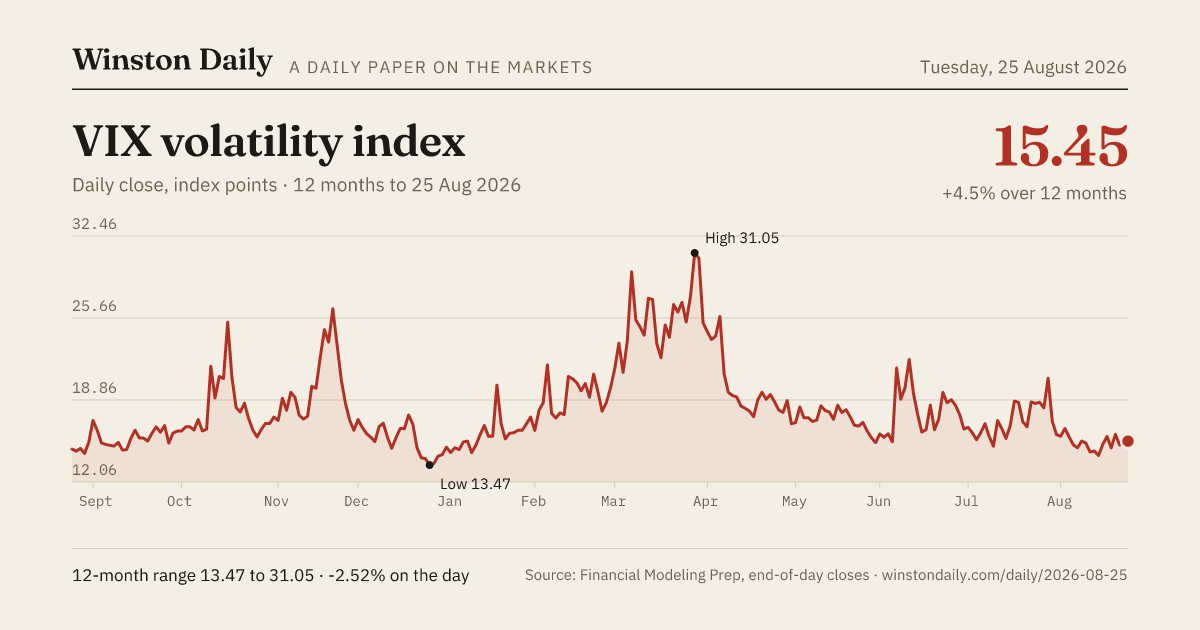
The S&P 500 closed at 7,677.28, up about a quarter of a percent. The VIX, which measures how much turbulence traders expect over the next month, fell to 15.45. Looks fine.
But a separate fragility gauge, a Wall Street measure of how close markets are to breaking, hit 1 on 19 August. That is the highest it can go. Last time it peaked was December 2024, and volatility spiked soon after. So the cheap insurance says relax, and the warning light says don't. That tension sits underneath everything today.
Bonds and the Druckenmiller warning
Stanley Druckenmiller said Treasury Secretary Scott Bessent's bond buybacks, where the government buys back its own debt early to push yields down, will not work. His words: the long-term Treasury yield is the only fiscal disciplinarian the U.S. has left.
Now, Druckenmiller trained Bessent. They ran money together.
The 10-year yield eased to 4.644% today. But the 30-year touched 5.33% last week, near its highest since 2007. If you have a mortgage coming up or you run a business that borrows, those numbers set your cost. Treasury doubled its buyback size to over $4 billion per operation this month. Relief lasted a day.
$40 trillion in federal debt. Interest alone runs over a trillion dollars a year. And Druckenmiller is saying you cannot manage that with clever bond trades, because the market is bigger than the Treasury. So does the 30-year keep climbing? Watch that number, not the next Treasury announcement.
Oil drops on sanctions nobody believes
Brent crude fell more than 5% to $87.28. WTI dropped over 3% to $82.17. You would expect the opposite when the U.S. declares economic war on a major oil producer.
Bessent unveiled 'Operation Economic Outcast,' dozens of new sanctions on companies, ships and individuals tied to Iran. But the real target is China. He warned Chinese banks they would be cut off if they keep turning Iranian oil into money. Beijing said it would retaliate. And it said it will not stop doing business with Iran.
China buys about 90% of Iran's oil exports. Roughly 12% of all the crude China imports. So will Bessent actually sanction Chinese banks? Hitting them would disrupt hundreds of billions in trade a year. Not hitting them makes the whole thing toothless. Watch whether Chinese tankers stop loading. That is your answer.
Warsh and the Fed
Kevin Warsh has been Fed chair for about 100 days. Jackson Hole runs Thursday through Saturday. July headline CPI came in at 3.4%. The 30-year yield sits near 5.25%. And the government just slapped 50% tariffs on $20 billion of Canadian goods.
How do you manage all of that at once? One idea is that Warsh wants the Fed to be less predictable, which would be a big shift. For the last decade the Fed told you what it planned before it did it. If that changes, every future meeting gets more volatile for your portfolio. Not less.
SEC subpoenas and consumers
Goldman Sachs, Citigroup, JPMorgan Chase and Bank of America all got SEC subpoenas, formal legal demands for documents, over their lending to an AI hedge fund called Situational Awareness. The fund nearly collapsed. The regulator wants to know how much borrowed money fuelled those bets.
Subpoenas do not mean charges. But probes like these take months, and if you hold any of those 4 names you are along for the ride.
Consumer confidence slipped to 89.4 in August from 90.2 in July. The drop came from expectations, people feeling worse about jobs and business ahead. When the mood turns, spending follows. And spending drives roughly two-thirds of the U.S. economy.
Home prices rose 1.5% annually in June, even with mortgage rates near 6.65%. Why? Not enough homes for sale. If you locked in a 3% mortgage in 2021, selling means taking on a new loan at double the rate. So you stay put.
Metals at time of writing
Gold spot sits at $4,654.61. Silver at $68.59. Copper at $6.70 per pound.
Reports describe a tanker struck 9 nautical miles off Oman's coast while under U.S. Navy escort. Tanker crossings through the Strait of Hormuz are reportedly up 400%. Iran's currency has crashed past 2 million rial to the dollar. All of that keeps safe-haven demand firm, and gold near record highs tells you something about how far trust in government debt has stretched.
Earnings round-up
Scotiabank beat on both lines. Revenue $7.5 billion, 5.7% above estimates. Earnings per share $1.64 versus $1.53 expected. Net income rose to $2.9 billion. Operating margin, how much profit the bank keeps per dollar of revenue, reached 21.3%, up from 15.7% a year ago. Steady climb all year.
BMO beat on earnings at $3.96 versus $3.73. But net income dropped 35% from last quarter to $1.7 billion, and free cash flow margin, the cash actually generated from revenue, swung to negative 68%. The headline number looked fine. The rest did not.
HEICO beat earnings by 9.9% and revenue by 4.2%, with free cash flow margin rising to 22.8%. Zoom beat on earnings at $1.55 but revenue barely moved. Box matched earnings and nudged revenue 0.6% higher. And Electromed beat earnings by 23.1% on its 4th straight quarter at $19 million in sales.
What is scheduled next
Jackson Hole runs Thursday through Saturday. Warsh's speech is the one that sets the tone. Nvidia reports earnings this week. And if you want to know whether Iran sanctions have teeth, track tanker traffic through the Strait of Hormuz over the coming days. Not press conferences.
About this issue
Issue compiled from the Tuesday, 25 August 2026 desk notes. Page published Friday, 25 September 2026. Metal prices are spot at the time of writing. Figures come from the sources set out in the editorial standards. Corrections: [email protected].
Winston Daily is a publication, not a broker or adviser. Nothing on this page is investment advice. Prices and figures are as reported on the day and may have changed.