 Winston
Bonds heard Warsh but stocks just shrugged
Rate-hike odds nearly doubled to 60% after the Fed chair's Jackson Hole speech, yet the S&P 500 dipped a quarter of a percent.
Saturday, 29 August 2026
Kevin Warsh told the world he's ready to raise rates if inflation doesn't fall toward 2%. It sits at 3.3%. Bond traders believed him. The 10-year Treasury yield climbed to 4.72%. The 30-year pushed near 5.2%.
And stocks? The S&P 500 slipped 0.25% to 7,711.76. The market's fear gauge touched 14.43, its lowest of the year. So one market is pricing in a rate hike and the other is yawning. Both can't be right.
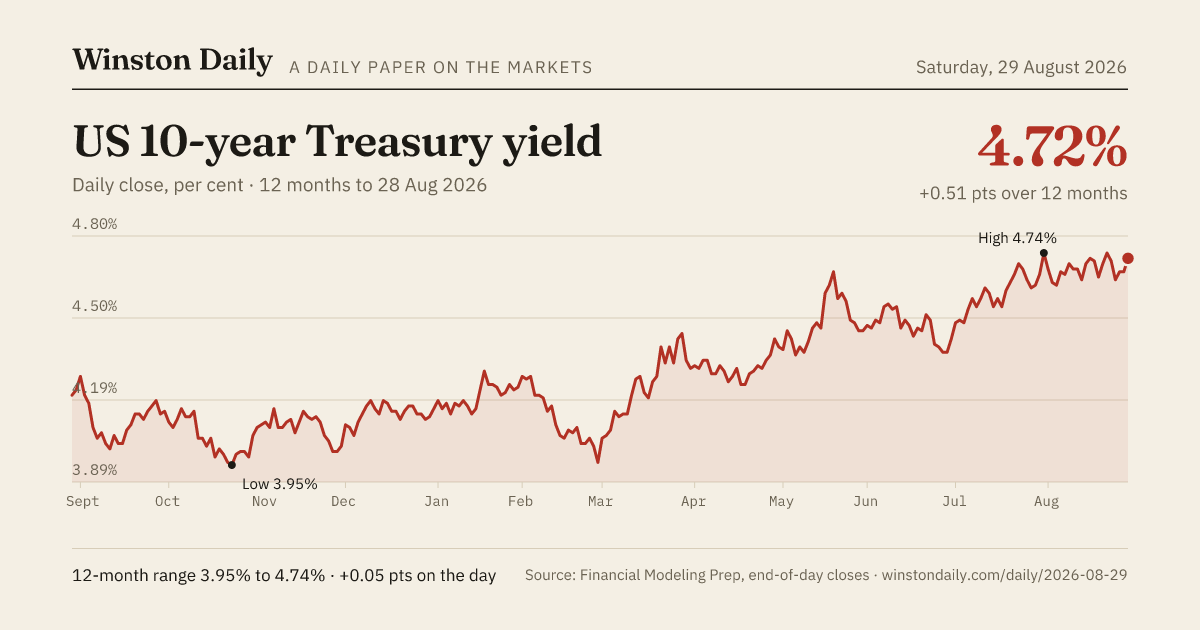
Bonds move, stocks don't
Before the speech, futures markets put the chance of a September hike at 35%. After it, nearly 60%. One day did that.
Now if you're carrying a variable-rate loan or waiting to lock in a mortgage, the cost of your debt just got repriced upward. You didn't do anything. The number moved on you.
The Nasdaq fell 0.52% to 26,402. The Dow lost 0.02% to 53,560.
So why the gap between bonds and stocks? Maybe you already suspected this was coming, because Warsh gave hawkish signals on Monday, Wednesday and Thursday of this week, and by Friday the surprise was gone from equities. But bond traders still had to reprice the actual cost of borrowing. That repricing is real. The calm in stocks might not be.
Oil and Venezuela
President Trump said the U.S. will take control of a fifth of Venezuela's oil reserves. More than 65 billion barrels. No signed treaty has been made public.
Think about the scale for a second. The entire U.S. Strategic Petroleum Reserve holds about 400 million barrels. So this announcement covers roughly 160 times that, which sounds enormous until you remember that owning reserves on paper and actually getting oil out of the ground are completely different things. Venezuela's fields have been mismanaged for years. Getting barrels flowing takes billions in investment and years of drilling.
Oil barely moved. WTI finished at $83.40. Brent at $88.10. And Persian Gulf exports have only recovered to about two thirds of pre-conflict levels. So if you're paying more at the pump right now, a promise of future barrels doesn't change your receipt.
The Fed's contradiction
Warsh says he won't use unconventional tools. But the Treasury under Secretary Bessent has been buying back its own long-term debt. That looks a lot like the market management Warsh says he opposes.
And the last buyback bought exactly one day of relief. One day. Then yields climbed right back.
So who's actually running bond policy? Can Warsh really hike? The government owes over $40 trillion. Raising rates on that pile adds tens of billions a year in interest costs, and you pay for that as a taxpayer whether you notice it or not.
Words are free. A rate hike is not.
Grain prices and jobs
Corn and wheat both hit 3-year highs. Two different problems hitting at once. Corn is up on tighter U.S. supply. Wheat is up because grain can't get out of the Black Sea.
And food prices feed straight into inflation. Which is awkward when the Fed just told you it isn't done fighting inflation.
Now look at the other side of the economy. The government cut 79,000 jobs from its earlier count this week. Help-wanted ads are falling. Consumer confidence dropped again in August.
GDP growth came in at just 1.5% last quarter. So you've got prices still rising too fast and hiring slowing at the same time. If you want lower rates, that's the worst combination, because the Fed can't cut to help growth without making the inflation problem worse. Does the next jobs report change that picture? Maybe. But Warsh didn't sound like a man looking for reasons to ease off.
Metals at time of writing
Gold spot sits at $4,458.79. Silver at $66.43. Copper at $6.66 a pound.
$4,459 an ounce for gold. Barely changed from yesterday's close of $4,454.99. But zoom out from the daily move. That's a lot of money buying insurance against inflation even while equities shrug. What does it tell you about what people really think of the dollar's purchasing power, whatever Warsh says at a podium?
Banks pull Delaware Life
Truist and Fifth Third stopped selling insurance products from Delaware Life. Federal investigators are looking at roughly $20 billion in assets tied to other businesses controlled by the same owner, Mark Walter, the billionaire behind the Los Angeles Dodgers.
TWG Global, his holding company, said there has been no fraud.
If you own an annuity sold through either bank, that's a contract where an insurer promises you regular payments, often in retirement, and your contract still stands. But two banks decided the risk of keeping those products on the shelf wasn't worth it while investigators dig. And if more banks follow, you'll know the denial wasn't enough.
Prediction markets in court
The Ninth Circuit ruled sports-related event contracts are gambling, not derivatives. An earlier appeals court said the opposite. Two circuits, opposite answers. So the Supreme Court almost certainly takes this up.
Why does the label matter to you? If these platforms count as derivatives, federal rules apply everywhere. If they're gambling, every state decides for itself. Some states ban gambling outright. So depending on where you live, you may lose access to prediction markets entirely, or you may keep it. Nobody knows yet.
What is scheduled next
The August inflation report lands before the Fed's September meeting. Warsh told you that's the number he's watching. Next week also brings a fresh jobs report. If hiring keeps weakening while inflation stays above 3%, the Fed gets boxed in. And if you're a borrower, that box means your costs stay high regardless of what the economy does around you.
About this issue
Issue compiled from the Saturday, 29 August 2026 desk notes. Page published Friday, 25 September 2026. Metal prices are spot at the time of writing. Figures come from the sources set out in the editorial standards. Corrections: [email protected].
Winston Daily is a publication, not a broker or adviser. Nothing on this page is investment advice. Prices and figures are as reported on the day and may have changed.