 Winston
Warsh floats a rate hike while hiring gets worse
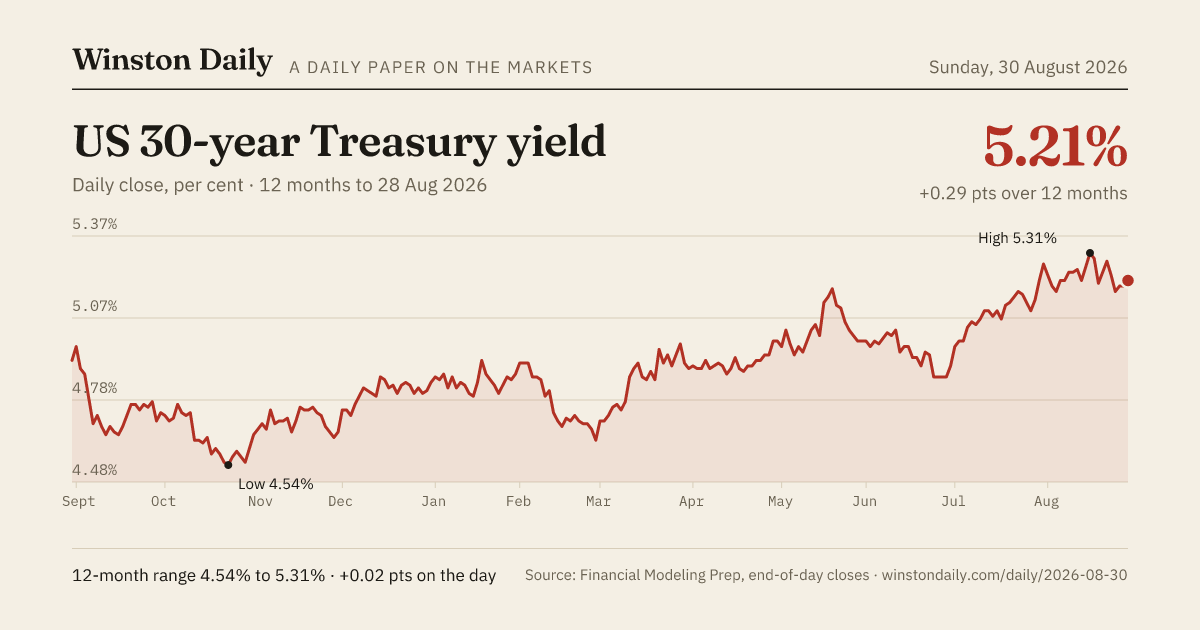
The 30-year government borrowing cost hit 5.19%, its highest since 2001, and August payrolls slowed again with 79,000 prior jobs wiped from the books.
Sunday, 30 August 2026
Kevin Warsh spent the week telling you he might raise rates. Three speeches in four days at Jackson Hole. Each one louder. By Friday he called inflation "quite elevated" and left the door open to a September hike. Bond traders moved fast, pushing hike odds to nearly 60% from about 40%.
But the job market is going the other way. August hiring slowed for a second straight month. And earlier counts got revised down by 79,000 positions. So the economy created fewer jobs than you were told it did, and now the Fed wants to tighten into that.
Bonds lead, stocks shrug
The 30-year Treasury yield, the interest rate the government pays to borrow for 30 years, touched 5.19% on Friday. Highest since 2001. The 10-year sits at 4.72%. And the 2-year jumped 11 hundredths of a percentage point in a single session.
Now if you carry a variable-rate loan or you're about to refinance, those are the numbers that decide what you pay next quarter.
Stocks barely flinched. S&P 500 slipped a quarter of a percent to 7,711.76. Dow lost 9 points. Nasdaq fell harder, down half a percent to 26,402.
And the VIX, which measures how much turbulence stock traders expect, just sat there at 14.43. Like nothing was happening. But gold had a 3% single-day drop on Friday and still held near record levels, which tells you plenty of money is hedging against exactly the kind of mess the VIX is ignoring. So you've got bonds screaming one thing, gold nervous, and equities priced for a soft landing that neither of those markets believes in. Which side are you on?
Oil and the Gulf
Six months into the Iran conflict and 60% of the oil that used to flow through the Persian Gulf still isn't flowing. Exports sit at roughly 40% of prewar levels. Brent closed Friday at $88.10. WTI at $83.40. Neither budged.
Now the Trump administration struck a 25-year deal for more than 65 billion barrels of Venezuelan reserves, roughly a fifth of the country's total. Venezuela's interim president said the target is 1.5 million barrels a day. And the U.S. plans a 35% stake in a Venezuelan energy company called North American Blue Energy Partners.
Sounds big. But Venezuela hasn't pumped anywhere near that in over a decade and the infrastructure has been falling apart for years. So why didn't 65 billion barrels move the oil price? Because the market knows the difference between reserves in the ground and barrels on a ship, and right now it doesn't trust the timeline.
The Fed's box
The PCE price index, which tracks what you actually spend each month, is running at 3.3%. Target is 2%. It hasn't moved. So Warsh has a reason to sound tough.
But GDP growth came in at 1.5% last quarter. Payrolls are weakening. Past job numbers keep getting marked down. Can this economy actually absorb a rate hike?
And who benefits from you believing one is coming? The Fed does. A credible threat can slow your spending before a single rate move happens, which buys time without costing anything. But that trick only works if the economy holds together, and Warsh hasn't said a word about what happens if it doesn't. You're left guessing.
Yen risk
Treasury Secretary Bessent warned that a sudden sharp swing in the yen could trigger forced selling across global markets. Japan spent $99 billion in a single month trying to stop the yen from falling. That pace cannot last.
So picture what happens next. Traders who borrowed cheap yen to buy other assets, including U.S. bonds, suddenly have to sell everything at once. Your borrowing costs go up on top of whatever the Fed does.
Bessent's Treasury has been running bond buybacks, where the government buys back its own debt early, to keep the market orderly. A yen crisis would undo that overnight. And Japan's foreign reserves are the thing to watch here, because when those shrink fast, that's when the selling you'd actually feel in your mortgage rate begins.
Software held up
You heard the fear all year. AI would replace subscription software, companies would cancel, chatbots would do the work. A batch of earnings this week pushed back on that. Cisco was a top contributor to large-cap returns in the second quarter. Nova, which makes measurement tools for chipmakers, posted record sales and guided for roughly $1.27 billion in revenue next year.
Are customers actually cancelling? This week's numbers say no.
But not one of those reports broke out how many customers renewed versus how many let subscriptions lapse. So you still can't tell if AI is adding revenue or slowly eating it. That renewal number is the one that matters and nobody gave it to you yet.
Metals at time of writing
Spot gold sits at $4,458.48 an ounce. It closed Friday at $4,529.90 and was $4,664 on Thursday, so that's a sharp drop in 2 days and it's still near record territory.
Spot silver is $66.28. Copper is $6.63 a pound. Both drifted lower. But gold at $4,458 after a 3% single-day fall tells you something about how much money is still hiding in it, even when the Fed is talking tough.
Two banks walk away
Truist Financial and Fifth Third Bancorp stopped selling Delaware Life insurance products on Friday. Federal investigators are looking at how Mark Walter's insurance empire reported about $20 billion in assets tied to companies Walter controls. Walter owns the Los Angeles Dodgers.
His holding company said Wednesday there has been no fraud. Two days later both banks pulled the products anyway.
When 2 compliance teams independently decide the risk of keeping something on the shelf outweighs the revenue, you should pay attention. If you own a Delaware Life annuity, most states guarantee benefits up to $250,000 per owner. But where did that $20 billion actually sit? And who controlled it? If more banks follow Truist and Fifth Third off the shelf, that question gets harder for TWG Global to leave unanswered.
What is scheduled next
The September inflation report lands days before the Fed's next meeting. If PCE stays near 3.3%, Warsh has left himself almost no room to stand still, and you'd feel a hike in your mortgage and your car loan before the quarter is out. Japan's foreign reserves will tell you whether the yen intervention can keep going. And count the banks that follow Truist and Fifth Third away from Delaware Life, because that number is your early warning.
About this issue
Issue compiled from the Sunday, 30 August 2026 desk notes. Page published Friday, 25 September 2026. Metal prices are spot at the time of writing. Figures come from the sources set out in the editorial standards. Corrections: [email protected].
Winston Daily is a publication, not a broker or adviser. Nothing on this page is investment advice. Prices and figures are as reported on the day and may have changed.