 Winston
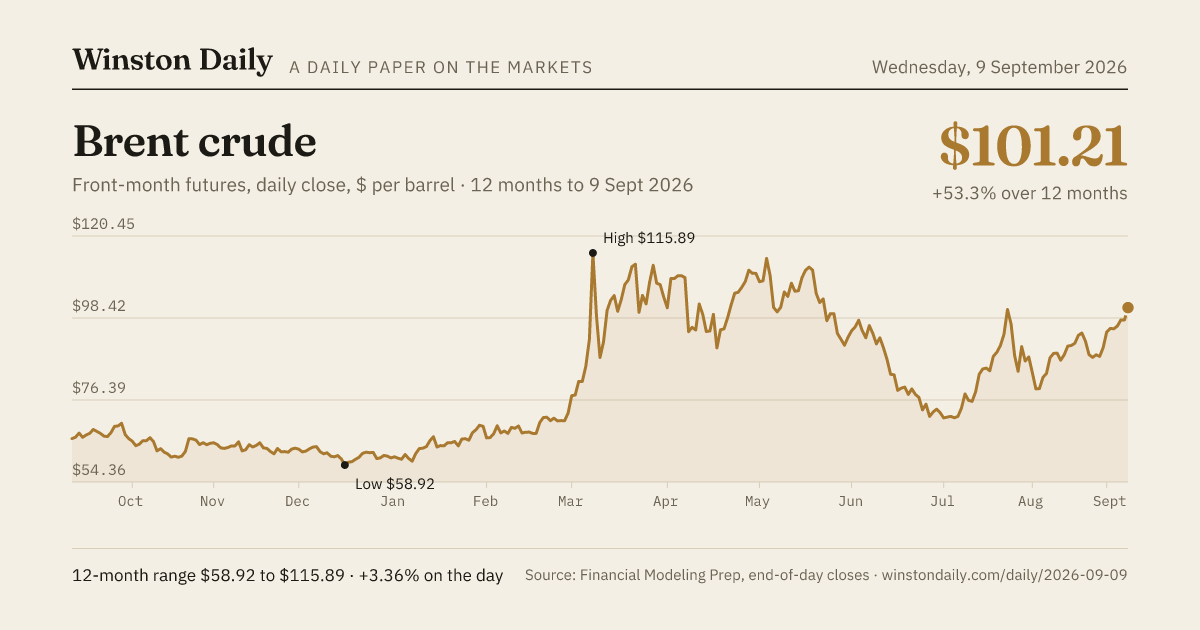
Oil tops 100 dollars and the Treasury's 6 billion dollar intervention falls flat
Brent crude hit $101.65 on U.S.-Iran fighting, the government tried buying back its own bonds to bring borrowing costs down, and rates rose anyway.
Wednesday, 9 September 2026
Brent crude closed at $101.65 on Wednesday. First time above $100 since July. The U.S. said it destroyed five Iranian oil vessels. Iran's Revolutionary Guard said it hit two American ships and eight tankers in return. Nobody is backing down.
So the Treasury stepped in with a $6 billion bond buyback, where the government buys back debt it already sold, triple the usual size, and the whole idea is to push borrowing costs lower. But the 10-year yield, the interest rate that flows into your mortgage and your car loan, rose to 4.836%. If you're carrying debt, that number just got more expensive for you.
The S&P 500 fell 0.47% to 7,637.70. The Dow dropped about 405 points. Nasdaq lost 0.62%.
Bonds would not cooperate
A buyback is supposed to push bond prices up and yields down. That's the whole point. But $6 billion against a market this size is like throwing a bucket of water at a house fire, and rates went up anyway, so you know it didn't work.
Treasury Secretary Scott Bessent has now tried to calm the bond market at least twice this month. He defended U.S. bonds at the G20 on September 1. He tripled the buyback on Wednesday. Neither moved the needle.
So who actually benefits from you believing buybacks can hold rates down? The Treasury does. It needs to sell more debt in the months ahead, and if you're a taxpayer, lower rates make that cheaper for you.
Now look at what the futures market is saying. Fed funds futures price a 62% chance of a rate hike before December, up from 58% a week ago. The average 30-year mortgage rate rose to 6.85% last week. And 8.5% of mortgage applicants are switching to adjustable-rate loans for a lower starting payment. You can read that as people stretching to afford a house they could have bought for less two years ago.
Oil and the Gulf
Oil has climbed from $90 to $101 in nine days. September 1, strikes pushed it past $90. September 3, missiles hit Kuwait, it topped $96. September 7, Saudi facilities were hit. Now vessels are being destroyed. And diesel already hit a record $5.85 a gallon last week, so if you drive or buy groceries, you're already paying for this.
Eighteen of the world's biggest shipping nations warned this week that conflict and trade barriers are building permanent costs into supply chains. Not a temporary spike they expect to fade. Permanent, baked-in costs that show up at your register.
Can tankers actually move through the Strait of Hormuz right now? About a fifth of the world's oil passes through it. That's the question worth asking, and press conferences won't answer it.
Europe's gas squeeze
European gas prices hit their highest since 2023.
Storage covers only a mild winter. No cushion beyond that. And Europe and Asia are fighting over the same pool of liquefied natural gas, which is fuel chilled into liquid so ships can carry it across oceans. If you heat a home in Germany or the Netherlands, your winter bill depends on whether enough tankers show up before the cold arrives.
So how cold does it get? Nobody knows yet. But a harsh October drains reserves fast, and that's only weeks away.
Trade war turns harder
Washington will block Canadian dairy, alcohol and motorbike imports starting September 29. Canada moved first on Monday with retaliatory tariffs covering CA$27.6 billion of American goods, roughly $20 billion U.S. So if you buy Canadian cheese or whisky, you won't find it on shelves much longer.
And if you sell American furniture or appliances into Canada, your customers just got a price hike they didn't ask for. U.S. midterm elections land in November, which creates pressure to settle. But no talks have been announced, and an outright import ban is a bigger weapon than a tariff. Does either side even want to negotiate right now?
A bear market hiding in plain sight
Here's something strange. The S&P 500 is up 12.9% for the year. But every major AI stock, every single one of the big hyperscalers building massive AI systems, fell at least 20% from its peak at some point in 2026. That's a bear market by Wall Street's definition, and you wouldn't know it from the index.
How? Energy surged. Other parts of the market filled the gap. The pain in AI got averaged away into a number that looked fine.
So if you only watched the index, you saw calm. Gina Martin Adams of HB Wealth says the danger zone for stocks used to start around a 5% yield on the 10-year. She thinks it's moved higher now, closer to 5.5%. But at 4.836% you're getting uncomfortably close, and the question is what happens to the broad index if rates keep climbing while its biggest names are already beaten up.
Spot metals
Gold spot at time of writing was $4,394.09, up from a previous close of $4,350.03. Silver spot was $67.05, up from $65.42. Copper sat at $6.85 per pound.
Oil up. Gold up. Silver up. Stocks down. You don't need a chart to read that.
Earnings
Chewy reported Q2 revenue of $3.3 billion, flat for three quarters running, but earnings per share came in at $0.20 against a $0.18 estimate and net income doubled to $81 million. The profit came from cost control, not growth, and that distinction matters if you own the stock.
Cognyte Software beat earnings by 71.4% on $109 million in revenue, with software revenue growing 21% year on year. Profits are thin. Cash flow is still negative. But the top line is moving.
Core & Main hit $2.1 billion in revenue with earnings of $0.94 a share, a small beat. SailPoint matched on revenue at $309 million and beat earnings slightly, though it still lost $50 million in the quarter. And then there's Nano-X, which missed revenue by 22.7% and posted a gross margin of negative 1,050.9%, meaning it spent over 10 dollars for every dollar it earned. That is not a typo.
What is scheduled next
Friday's CPI report, the government's monthly inflation reading, is what decides where rates go next. If it comes in hot with oil above $100 and the 10-year yield already sitting near 4.84%, that 62% chance of a Fed rate hike could look low by the weekend. But if prices cooled, the whole hike story could unwind just as fast. You'll know Friday morning.
About this issue
Issue compiled from the Wednesday, 9 September 2026 desk notes. Page published Saturday, 26 September 2026. Metal prices are spot at the time of writing. Figures come from the sources set out in the editorial standards. Corrections: [email protected].
Winston Daily is a publication, not a broker or adviser. Nothing on this page is investment advice. Prices and figures are as reported on the day and may have changed.