 Winston
US borrowing costs hit 5% for the first time since 2007
A Saudi pipeline went dark, oil jumped past $106, and the Fed is expected to raise rates on Wednesday into all of it.
Monday, 14 September 2026
The interest rate the US government pays to borrow for 10 years touched 5% during Monday's session. Settled at 4.962% by the close. You have not seen a 5 on that number since 2007.
And the S&P 500 barely flinched. Down half a per cent to 7,620. Dow lost 152 points to 52,421. Nasdaq off 0.56%. But the VIX, which tracks how much volatility traders expect over the next month, jumped 8% to 17.1. Somebody is buying protection.
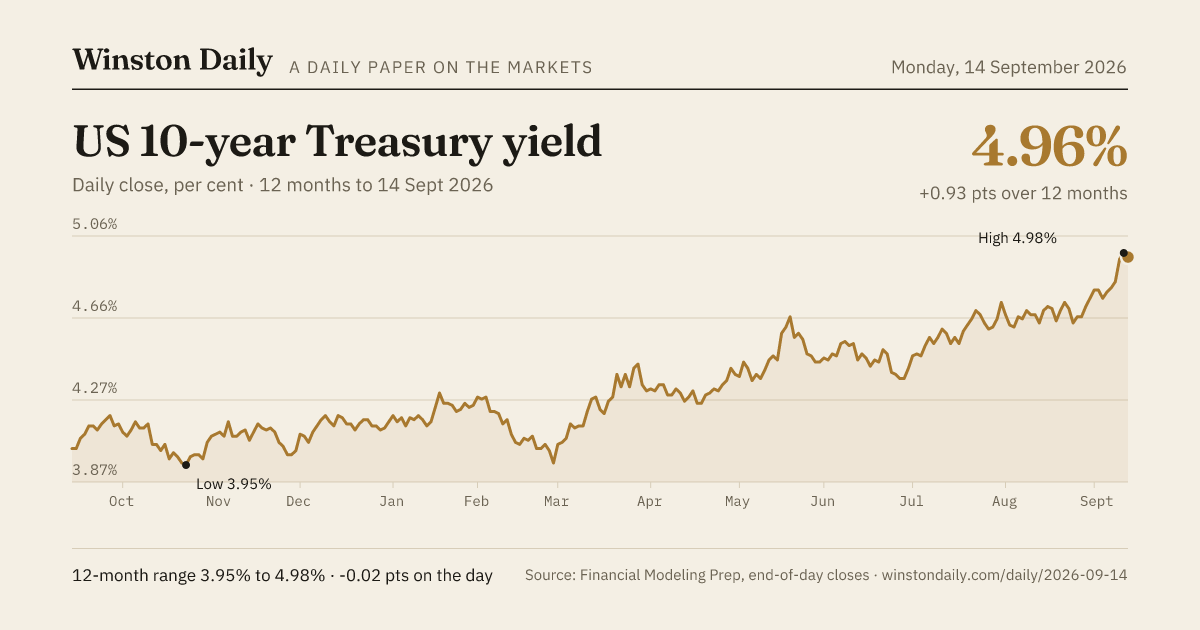
What 5% means for you
The 10-year rate sets the floor for almost every long-term loan in the country. Your mortgage. Your car payment. The cost of building a factory.
So why did it spike? Oil above $106 feeds straight into inflation. The federal deficit hit $2 trillion with a month still left in the fiscal year, so Washington keeps flooding the market with new bonds it needs someone to buy. And the Fed is about to raise rates on Wednesday.
Now add Japan. The Bank of Japan is expected to keep raising its own rates, and Japanese investors hold trillions in American bonds, and if the gap between what you earn lending to Washington versus lending to Tokyo shrinks enough, some of that money goes home.
So who buys the next batch?
Oil and the pipeline
Drone attacks shut down Saudi Arabia's East-West pipeline. Roughly 4% of global supply, according to industry estimates. No repair date.
Brent closed at $106.20. WTI at $101.83. But a 4% supply outage only moved oil less than 2%, which either means traders expect a fast fix or the risk was already in the price, and you would want to know which one before you stop paying attention.
Diesel is the one that reaches your kitchen. It was $5.85 a gallon on 6 September, a record, and it has not come back down. Diesel moves the trucks that carry your food and the ships that bring your clothes, so when it stays expensive those costs land in what you pay at the shop within weeks.
On Kalshi, a prediction market, traders put better than 70% odds on petrol crossing $4.60 a gallon this year.
The Fed on Wednesday
Chair Warsh faces his first rate increase since taking over. Inflation at 3.4%. Oil above $100.
And yet stocks are near record highs. Strong economy forces a rate hike. Expensive market punishes one. President Trump wants the opposite, threatened on 5 September to halt trade with surplus nations unless the Fed cut. Ten days later the Fed is about to do exactly what he told them not to.
The hike itself is priced in. What you want to listen for is whether Warsh signals another one after that.
AI builders want a pause
Dario Amodei at Anthropic called on AI companies to slow down. Sam Altman at OpenAI agreed. So did Elon Musk at xAI.
All 3 compete with each other. Genuine worry about safety, or does a pause lock in the lead for whoever is already ahead? If you own chip stocks the maths is blunt, because fewer giant models means fewer giant chip orders, and nobody told the share prices that yet.
Oracle's Larry Ellison cancelled a plan to sell up to $7.5 billion of his own shares. $7.5 billion. Cancelled.
Private credit's blind spot
Private credit funds lend to companies banks won't touch. Now some of those funds are borrowing against their own holdings. Debt on debt. And current SEC rules don't make them say how much.
Your pension or insurance company probably owns some of this. With rates near 5%, every extra layer of borrowing gets squeezed harder, and if losses show up and those hidden debts come due the forced selling can ripple into accounts you thought were boring and safe.
Metals at the spot
Gold spot sits at $4,288.57 tonight, down from a prior close of $4,332.96. Silver spot at $62.99, off from $63.74. Copper spot $6.39 a pound. All 3 red.
Gold is still 19.9% below its 6-month high of $5,405 from January. But look at the vault. A big New York exchange stores physical gold bars, and that pile is down to 15.12 million ounces from 18.80 million a year ago. Someone has been steadily taking delivery, which tells you demand for the real metal is running in a different direction from the price.
Bonds pay you interest. Gold just sits there. So when bond rates climb, gold gets less attractive, and that tug of war is exactly what Wednesday's Fed decision lands on.
Crypto bill and the EPA
The Senate cleared a first procedural vote on the biggest crypto bill ever written. Trump dropped ethics restrictions he'd fought for months, including letting state attorneys general enforce conflict-of-interest rules. Floor vote is Tuesday.
And the EPA said it will repeal carbon limits on coal and gas plants. Announced while G-20 leaders are meeting on climate. But new power plants take years to build and the grid is already strained. So your electricity bill this winter probably does not change because of it.
What is scheduled next
The Fed announces its rate decision Wednesday and Chair Warsh speaks afterwards. Tuesday brings the Senate floor vote on the crypto bill. And there is still no repair timeline for the Saudi pipeline. If you want to know whether the supply gap is real, watch tanker traffic through the Strait of Hormuz.
About this issue
Issue compiled from the Monday, 14 September 2026 desk notes. Page published Saturday, 26 September 2026. Metal prices are spot at the time of writing. Figures come from the sources set out in the editorial standards. Corrections: [email protected].
Winston Daily is a publication, not a broker or adviser. Nothing on this page is investment advice. Prices and figures are as reported on the day and may have changed.