 Winston
Borrowing costs hit a level not seen since 2007
Oil broke past $105 on a Saudi pipeline attack and the 10-year rate touched 5%, so stocks fell hard.
Tuesday, 15 September 2026
The interest rate the US government pays to borrow for 10 years touched 5% on Tuesday. Closed at 4.995%. That has not happened since 2007.
And oil jumped with it. WTI crude rose 4.5% to $105.94. Brent hit $108.59. A Saudi pipeline has been shut since Saturday after a drone from Iraq, knocking roughly 4% of world supply offline. Three days now. Still not flowing.
Stocks got squeezed from both directions. The S&P 500 fell 0.45% to 7,585.51. The Nasdaq dropped 0.78%. The Dow lost 328 points.
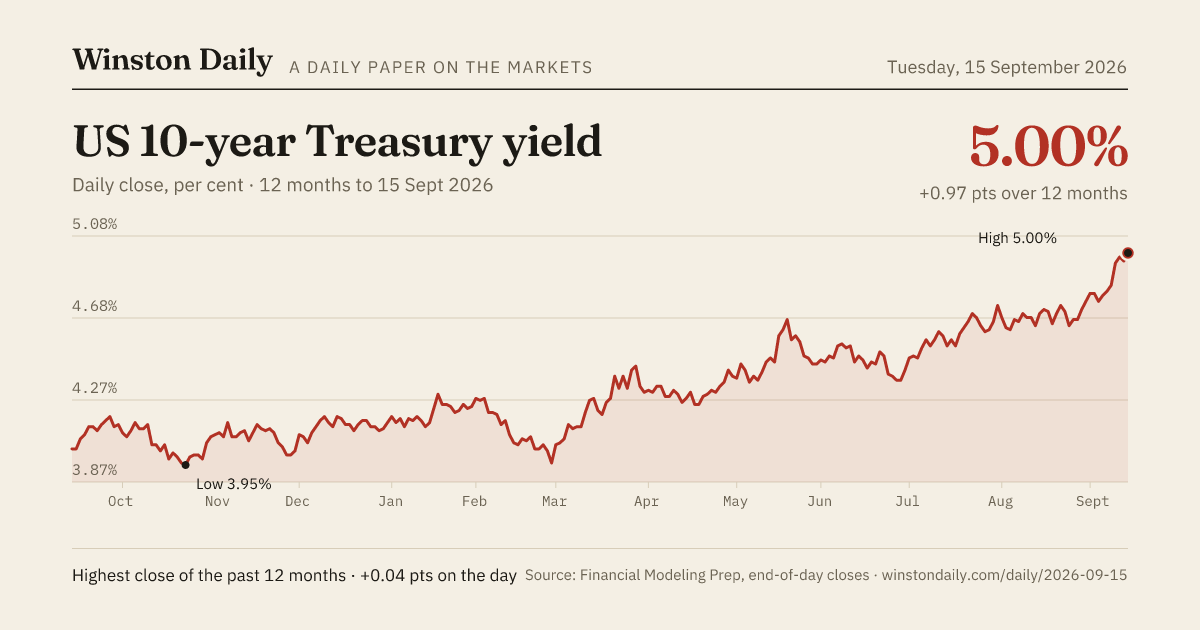
Bonds and stocks
5% on the 10-year. If you carry a mortgage or a car loan, that is the number that decides what you pay each month. And it just hit a level you have not seen in almost 20 years.
Now a Bank of America survey of global fund managers says a disorderly rise in bond yields is their top fear. Six months ago the worry was overpriced AI stocks. The worry moved.
And then there is the VIX, which measures how much volatility traders expect. It settled at 17.2. Barely budged. You have got borrowing costs at 2-decade highs, crude spiking on a real supply disruption, and the fear gauge just sits there.
Is the market calm or numb? Hard to say, and that is not a comfortable place to be sitting with the Fed meeting already under way.
Oil and the pipeline
The Saudi East-West pipeline is still shut.
A drone launched from Iraq damaged it on Saturday. The US Energy Secretary called it a brief interruption lasting days. But you are on day 3 and the oil is not flowing.
So what does days mean? Every day that pipeline stays down, the price of everything you buy that moves by truck or ship gets a little bit worse. And that feeds straight into the inflation number the Fed is watching when it sits down tomorrow.
Saudi Arabia wants calm here. A longer outage means higher prices and harder questions about how a drone from Iraq reached that infrastructure. Watch the tanker schedules out of Yanbu for your real answer.
The Fed meeting
The 2-day meeting started today. Traders put the odds of a quarter-point hike on Wednesday around 87% to 90%, which would take the benchmark rate to 4%.
But the hike itself is priced in. What changed is everything around it. A month ago Wall Street expected 1 increase and done. Now surveys show at least 2 over the next 12 months.
About 3 quarters of respondents say the inflation problem goes well beyond energy. August inflation held at 3.4%. The Fed's target is 2%.
Wednesday afternoon brings something called the dot plot, the Fed's own forecast of where each official thinks rates are heading. That document matters more than the press conference, because right now the bond market does not believe 1 hike fixes anything. And Fed Chairman Kevin Warsh and Treasury Secretary Scott Bessent both need you to believe the government can keep selling its debt without yields spiralling further.
Trade and the G-20 vote
19 of the world's 20 largest economies voted to condemn China's trade surplus and state-run industrial policies. China stood alone. 19 to 1.
That gives Washington bargaining power heading into a Trump-Xi meeting on 24 September. But bargaining power and a deal are very different things, and if you own anything that crosses a border, the next 10 days matter to you.
Every government that wants tariffs on Chinese goods now gets to call it global consensus rather than 1 country acting alone. Which is the whole point of the vote.
Natural gas
Global natural gas prices have hit multi-year highs. European storage is reportedly at record lows, though no specific percentage came with that claim.
North American exporters benefit from this. Qatar has been hunting for US natural gas deals through 2031. But speculative money piles into energy every time a pipeline gets hit, so it is worth asking how much of the move is real scarcity and how much is positioning. If you heat your home with gas, you feel it regardless.
Metals
Gold spot sits at $4,282.17 right now. Down from Monday's close of $4,288.57.
It is 20.4% below its January high of $5,405. That peak feels a long way off. And the big banks keep adding bets against it, now holding 239,313 more short positions (bets that the price falls) than long, up nearly 6,000 in a single week.
When 1 side of a trade gets that crowded the exit gets narrow. If you hold gold you are on the opposite side from those banks. They added to their position last week.
Silver spot is $63.50. It takes 68.1 ounces of silver to buy 1 ounce of gold today, up from 62.1 three months ago. Silver keeps losing ground.
Copper spot is $6.46 a pound. A week ago it was $6.77. More than 5% gone in 5 trading days. Copper moves on factory demand, so that drop is telling you something about where traders think the economy is headed.
What is scheduled next
Wednesday brings the Fed rate decision and press conference in the afternoon, along with the dot plot showing how many more hikes officials expect. Before that, August retail sales data lands in the morning. Economists expect a 0.8% bounce after last month's 0.6% drop. A strong number gives the Fed even less room to pause.
About this issue
Issue compiled from the Tuesday, 15 September 2026 desk notes. Page published Saturday, 26 September 2026. Metal prices are spot at the time of writing. Figures come from the sources set out in the editorial standards. Corrections: [email protected].
Winston Daily is a publication, not a broker or adviser. Nothing on this page is investment advice. Prices and figures are as reported on the day and may have changed.