 Winston
Government borrowing costs hit highest since 2007 as oil tops 107 dollars
The 10-year Treasury closed at 5.163% while Brent crude jumped 4.1% on fears the Iran conflict could widen, and stocks did absolutely nothing.
Thursday, 24 September 2026
5.163%. That's what the U.S. government now pays you to lend it money for 10 years. Hasn't been that high since 2007.
And the 30-year rate topped 5.25%, which takes you back to 2004. Now add oil. Brent crude jumped 4.1% to $107.31 a barrel on Thursday after Iranian officials said their war with the United States could get bigger. The S&P 500? It closed at 7,703.83. Moved 0.03%. Flat as a coin on a table while everything around it was screaming.
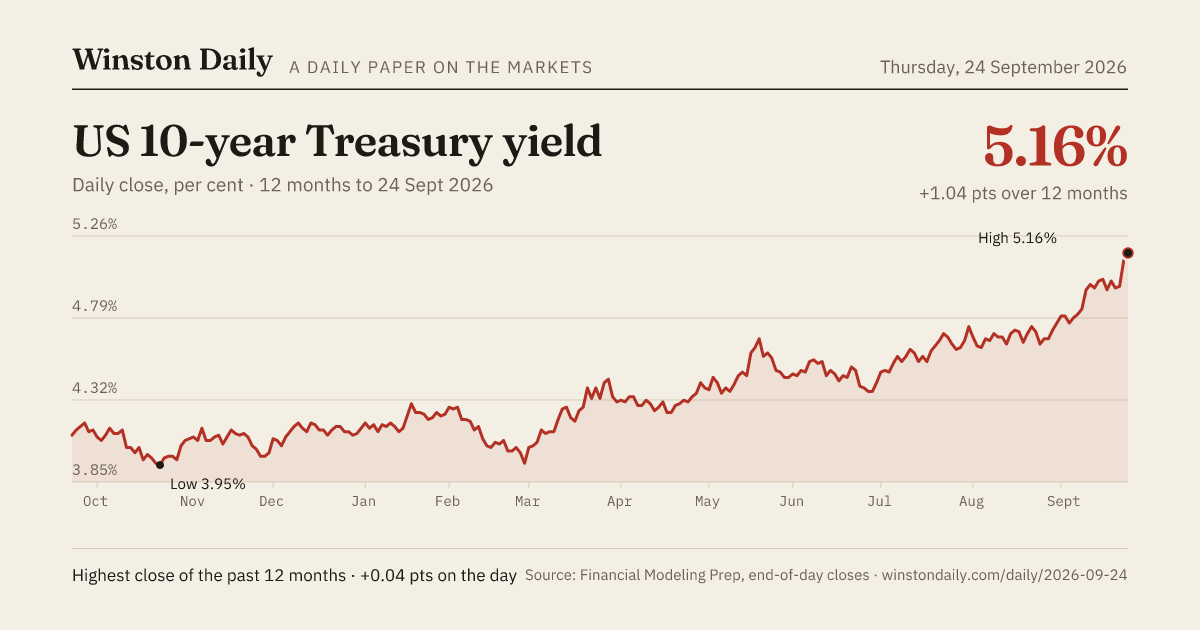
Bonds at generational highs
The 10-year was at 5.115% the day before. So it climbed again.
Mortgage rates crossed 7% this week for the first time since early 2025. What does 7% feel like if you're the one signing the papers? On a $400,000 loan you're paying about $230 more every single month than you would at 6%. Over the life of the loan that comes to roughly $83,000 extra. $83,000. That's a number worth sitting with.
And it's not just your mortgage. In the UK the 10-year gilt, the British government's version of a Treasury bond, climbed near a 19-year high. The chancellor has a budget coming. Every tick higher in borrowing costs shrinks what's left to spend on anything else, and right now governments on both sides of the Atlantic are fighting for the same pool of money. That pool is getting pickier.
Oil and the Gulf
Brent's 4.1% jump snapped a 5-day losing streak. WTI climbed 3.2% to $95.07.
Iran said the conflict could widen. But 2 days ago Iran had offered to reopen the Strait of Hormuz, the narrow waterway where roughly a fifth of the world's oil passes through. So that offer looks dead. Can Iran actually widen this war, or is the threat itself the weapon? Because you keep seeing the same pattern. Peace signal, oil drops. Harder line, oil jumps back. At least the second reversal in a week and nobody knows which version to price in.
Then there's diesel. Hit a record earlier this week. The White House floated an export ban, softened it to restrictions the next day, then did nothing. 4 of the biggest business lobbies in Washington sent a joint letter urging against a ban.
But U.S. refineries are already running near full capacity. You can offer refiners every incentive you want. If the plants can't run harder, no policy memo creates more fuel.
The Fed keeps talking
Philadelphia Fed president Anna Paulson said rates may need to go higher. She called the likely moves modest. Fed governor Warsh said the same on September 20. Boston Fed president Collins said it on Monday. That's 3 officials in 5 days.
And the Fed only raised rates for the first time in 3 years last week.
Now look at jobless claims. 197,000 new filings, the weekly count of people applying for unemployment help for the first time. Wall Street expected 201,000. Two weeks running below 200,000. Good if you have a job. But if you need your mortgage rate to come down? A labour market this strong tells the Fed the economy can still take more squeezing, and the Fed is listening.
Trump and Xi at the table
Xi Jinping landed at Andrews Air Force Base on Wednesday evening. Trade, AI safety, Taiwan, the Iran conflict. All on the agenda. Analysts broadly expect few concrete deals.
Wednesday's dinner put Xi across from the CEOs of Nvidia, Apple, Alphabet, Tesla, Citigroup and Dell. Think about that. Every one of those CEOs needs something from Beijing. Market access, chip supply chains. That gives China bargaining power at a summit where Treasury Secretary Bessent held surprise talks with Chinese officials just yesterday and still nothing got signed.
So what do you watch? Not the handshake photos. What gets put on paper.
Your grocery bill
An ag-tech executive warned that climbing diesel costs are squeezing farmers right before harvest. You feel that at the supermarket.
If export limits arrive but refinery output stays flat, you're looking at the same diesel shortage plus higher food prices heading into winter. And nobody has explained how you avoid both at once.
Metals drifting lower
Gold spot sits at $4,265.19 at the time of writing, down from a previous close of $4,289.17. Silver is at $63.44, off from $64.19. Copper trades at $6.77 a pound.
Gold is now 20.7% below its 6-month high of $5,405 set back in January. That's a big slide.
And physical gold in a major New York vault has dropped to 15.19 million ounces from 18.80 million a year ago. Somebody has been pulling metal out steadily and not putting it back. Where's it going? The data doesn't say.
Silver. It takes 67.0 ounces of silver to buy 1 ounce of gold today. A month ago it took 67.9. So silver is closing the gap on gold, even after this week's drop. Whether that keeps going depends a lot on what you think the Fed does next.
What is scheduled next
A 7-year Treasury auction lands on Friday. If you want to know whether your mortgage rate is done rising, watch what buyers actually bid. The weekly refinery utilisation number from the EIA is also due, and if refinery runs don't climb the diesel problem stays exactly where it is. Any signed agreement from the Trump-Xi summit would move more than the photos.
About this issue
Issue compiled from the Thursday, 24 September 2026 desk notes. Page published Friday, 25 September 2026. Metal prices are spot at the time of writing. Figures come from the sources set out in the editorial standards. Corrections: [email protected].
Winston Daily is a publication, not a broker or adviser. Nothing on this page is investment advice. Prices and figures are as reported on the day and may have changed.