 Winston
Government borrowing costs hit a 19-year high and stocks do not care
The 10-year Treasury rate reached 5.18% on Friday, its steepest since 2007, while all three major indexes climbed anyway.
Friday, 25 September 2026
The US government now pays 5.18% to borrow for a decade. That is the highest rate since 2007. And the S&P 500 rose 0.31% to 7,727.7.
Bonds say money is expensive. Stocks disagree. One of them is wrong.
Oil fell on another Hormuz promise. Gold lost ground. A crypto exchange froze $352 million in customer funds. And a Trump-Xi summit produced a handshake, a 2-month tariff extension, and nothing else.
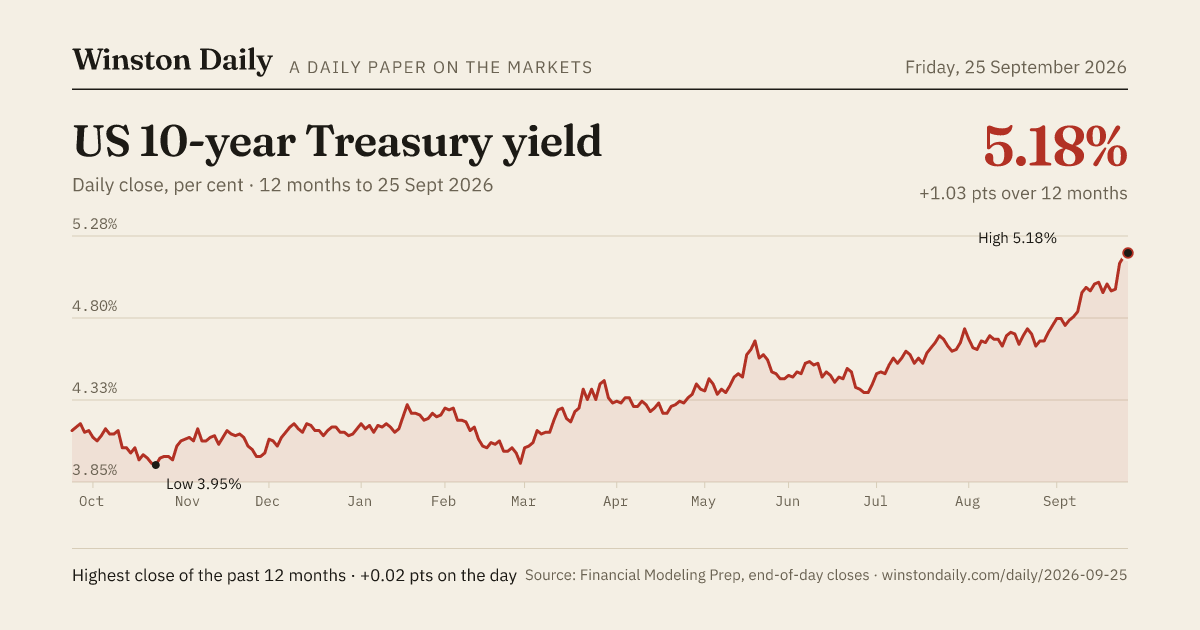
Bonds flash red, stocks yawn
5.18%. If you carry a mortgage or run a business that borrows, that number feeds directly into what you pay. It crossed 5% on 16 September. It has not come back down.
The Dow gained 0.57%. S&P 500 added 0.31%. Nasdaq rose 0.38%. The VIX, a measure of how nervous traders are, fell to 15.14, which is low by historical standards.
But the Michigan consumer confidence survey came in at 48.1. That beat the 47.6 forecast. It still fell hard from last month's 51.7.
So you have rising stock prices, falling confidence, and the most expensive government debt in 19 years. All at once.
Oil dips on a Hormuz promise
Brent crude fell 1.6% to $104.95 after a senior Iranian official said Tehran would reopen the Strait of Hormuz, the waterway that carries roughly a fifth of the world's oil, if the US ends its naval blockade.
A deal on exactly those terms was signed on 17 June. It fell apart within weeks.
And Saudi exports through Hormuz just topped 5 million barrels a day, the highest since the Iran conflict began. An attack damaged the kingdom's East-West pipeline, so that oil got rerouted through the strait. Now the backup route is broken and the main route depends on talks that have failed before. If you are watching oil prices for relief on your fuel bill, that is the tension you need to track.
The Fed goes quiet
Fed Chair Kevin Warsh has scrapped the old practice of signalling future rate moves. No dot plots. No coded phrases designed to nudge your expectations.
Every Fed chair since the mid-2000s used forward guidance, plain or coded hints about where rates were headed. Warsh has thrown that out. So now the 10-year rate moves on raw data instead of hints.
And the data pulls both ways. Jobless claims fell to 197,000, below forecasts. Consumer confidence dropped. At least 3 Fed officials have said more hikes are coming since 19 September. But Warsh himself has gone silent on direction.
The Fed also plans to raise the size thresholds that trigger its toughest bank rules. If you are a midsize lender, lighter oversight makes the maths on buying a rival a lot easier. But lighter oversight is what let Silicon Valley Bank pile up risks nobody caught until it was too late.
Trade truce, no trade deal
Treasury Secretary Scott Bessent announced a 2-month extension of US-China tariffs before Trump and Xi even sat down. No new agreement followed. No timeline for one.
American businesses did not wait. Orders for Chinese goods jumped in the weeks before the summit. If you buy from China, you front-loaded stock just in case. Now you have 2 more months of the same tariff rates. November is when you find out if that bet paid off.
Treasury's short-term debt gamble
Of $2.1 trillion in net new government debt, about 40% came as T-bills, short-term IOUs that mature within a year. The Treasury's own advisory committee says that share should be 15% to 20%.
Double the guideline. And nothing broke.
But short-term debt rolls over fast. If buyers balk next time, the Treasury pays more or shifts into longer bonds. Either way, your borrowing costs go up.
Metals at time of writing
Gold's spot price is $4,284.88. It started the week near $4,369. Roughly $84 gone in 5 sessions. Gold remains about 21% below its 6-month high of $5,405 set in January. When rates are high, bonds pay you interest for lending the government your money. Gold pays nothing. So bonds keep pulling cash away.
Silver sits at $64.11. Copper is $6.77 a pound, barely changed.
Soul Patts hits revenue, loses money
Washington H. Soul Pattinson, the Australian holding company, reported Q1 fiscal 2027 revenue of $873 million. That matched estimates exactly. But it posted a loss of $0.30 per share and a net loss of $112 million.
Gross margin fell from 71.2% to 31.2% in under 2 years. That is 40 points. Free cash flow margin, how much cash the company keeps from each dollar of revenue, jumped to 45.9% from 1.3% a year ago. But a quarter ago it was negative 96.9%. The company buys and sells big assets, and the swings show it.
What is scheduled next
The US-China tariff truce runs until November. Tanker traffic through the Strait of Hormuz over the next 2 weeks will tell you whether the Iran deal is real or vapour. Bitget has not said when withdrawals reopen after its $352 million hack. And October earnings season is the first test of whether companies can justify these stock prices against borrowing costs not seen in 19 years.
About this issue
Issue for Friday, 25 September 2026, published the same day. Metal prices are spot at the time of writing. Figures come from the sources set out in the editorial standards. Corrections: [email protected].
Winston Daily is a publication, not a broker or adviser. Nothing on this page is investment advice. Prices and figures are as reported on the day and may have changed.